15.12.2025
Special Report
A New Theme for the Project Pioneer Since 1911
Dear HEC Alumni Community,
The editorial team of Pioneers Since 1911 returns this year with undiminished enthusiasm and a new theme that is particularly close to our hearts—one inspired by the Master’s program in Information Systems and Digital Innovation (MScSI for those in the know), which is celebrating its 40th anniversary this year.
Before unveiling our new topic, let us briefly look back at the previous session dedicated to The Role of Taxes in Society. This theme was a real success and allowed our student journalists from HEConomist to weave the common thread of “past – present – future” through three different formats.
First, there was archival work centered on the writings of Léon Walras and his famous Critical Theory of Taxation: placed in its 1861 context, confronted with today’s debates, and meticulously explored by our students. Next, these same journalists—joined by the Innovation Time Lausanneteam—met several key figures from the French-speaking Swiss political and economic landscape: Councillor of States Pascal Broulis, former Vice President of the Swiss National Bank Jean-Pierre Danthine, and the Mayor (Syndic) of Échandens, Jérôme De Benedictis.
This exploration concluded in May with a roundtable discussion moderated by Mathilde Farine, co-director of the economics desk at RTS, bringing together the previous speakers as well as Samuel Bendahan, Member of the National Council and co-president of the Socialist group in the Federal Chambers. And because symbolism matters, we held this event in the Léon Walras Auditorium at Internef (formerly BFSH1).
We would like to take this opportunity to warmly thank everyone involved, as well as the hundred or so readers, listeners, and engaged participants. Thank you all!
Now let us turn to this new edition. We could have followed a chronological logic and continued, after Walras, with Pareto. But no—this year, we wanted to shake things up a bit and show that Pioneers Since 1911 can also tackle deeply contemporary subjects. And what could be more current than the digital world, that space where we learn, work, travel, meet… and live?
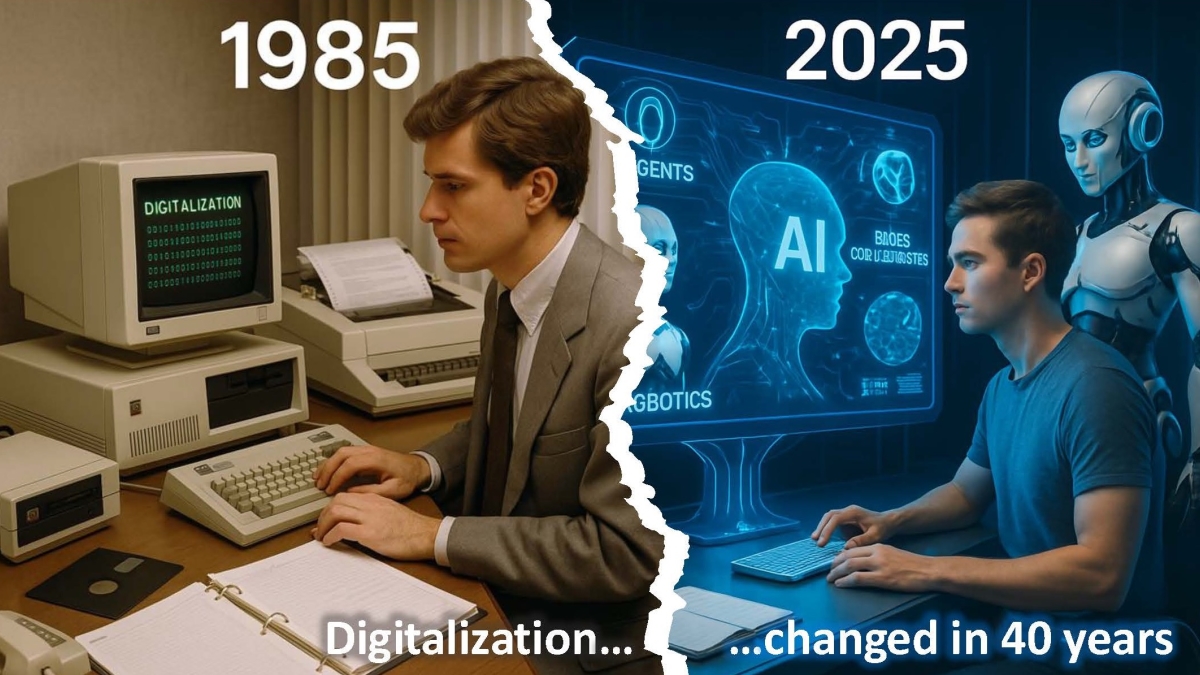
In 2025–2026, the MScSI (Master of Science in Information Systems) celebrates its 40th anniversary, along with a constant challenge: keeping pace with technology that evolves every day. The theme therefore imposed itself naturally: “The Metamorphoses of Digital Innovation.”
As always, we will approach this topic through the triptych “past – present – future.” This time, the past is only 40 years ago—an eternity in technology, yet still fresh in memory: the professors who have shaped the MScSI to date have only just stepped down from their roles. And the themes they championed, from cybersecurity to Big Data management, resonate today more than ever. Not to mention the famous Business Model Canvas, born at HEC Lausanne (with a small detour via Stanford… yes, we didn’t forget to mention it!).
As for the present and the future, the boundary between them is becoming thinner: the acceleration of digital technologies, the impact of digital on the physical world, and the dramatic arrival of artificial intelligence make the exercise almost philosophical. Our journalists will therefore have to trace this shifting line between what we are already experiencing and what lies ahead—a fascinating challenge.
At the same time, this session will offer us a deep dive into the evolution of technological tools thanks to the EPFL Bolo Museum, which is opening its doors to let us discover the “dinosaurs” of computing prehistory. A way to step back, admire the genius of the pioneers, and understand where we come from in order to better imagine where we are going. Keep an eye on the HEC Alumni Association’s agenda to sign up for this visit.
But at the heart of this edition lies the MScSI itself: a Master’s program that does not seek to “format” tomorrow’s developers, but to train managers capable of understanding information systems, supporting innovation, and integrating technology in the service of humanity. A Master’s program that questions performance as much as the environmental, social, and ethical impact of the tools it studies. A Master’s program that, in short, educates toward the subtle balance between technological progress and human responsibility.
We hope this new theme will excite you as much as it does us, and that you will join us in this exploration over the coming months. To our HEConomist journalists: dive into the subject matter—and to the Innovation Time Lausanne team: bring it to life through images and sound.
Happy reading!

Daniel Maman
Member of the Alumni HEC Lausanne Committee
Read the biography